The accomplished young Vera Quartet are truly in the springtime of their career. Visiting Saranac for the first time on September 29, they offered a terrific program, starting with Haydn’s Opus 76 in G Major and followed by the Ravel Quartet in F Major. On paper, the second half appeared a little sketchy: four individual movements from four quartets by Schubert, Schnittke, Auerbach, and Beethoven – what was up with that? Apparently it was required repertoire for a competition they had recently participated in, and they discovered that it hung together startlingly well. It was successful, too, for our audience in that it offered great variety – instead of only three composers, we heard six!
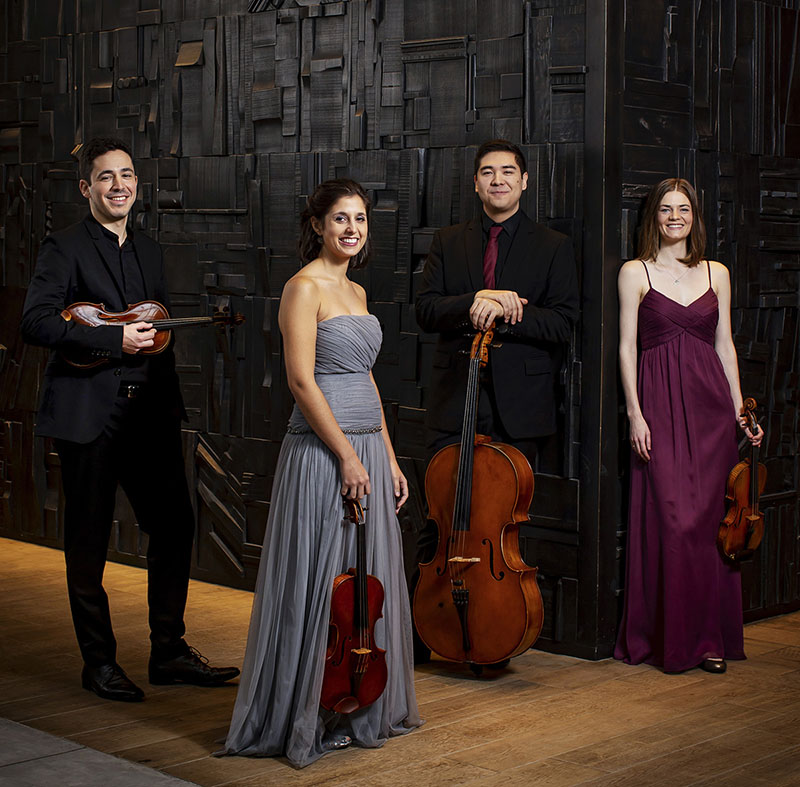
The Veras spent a day in the Peru Central School District, conducting workshops with middle and high school string students. The students were fabulously receptive to the quartet, eager to listen and learn. The intensive school day concluded with a live performance and Q & A by the Vera Quartet, which the beginning string students from the intermediate school were invited to attend, along with the older students. It was very cool to be a string player that day and be released from other classes!
The Vera Quartet then hit the road back to Philadelphia, where they are currently quartet-in-residence at the Curtis Institute, as well as under the wing of Astral Artists, whose competition they won in 2018. Undoubtedly we will hear more from this exciting young quartet, as they are sure soon to be in demand on concert series everywhere.
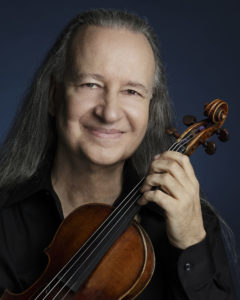 This concert was rather unusual in that it was a traditional violin recital featuring standard repertoire. Outmoded? You must be kidding! Think retro. Think vintage. And like vinyl, cool again! Arturo Delmoni delivered the quintessential virtuoso violin recital, partnered by the superb pianist Li-Pi Hsieh. It was utterly refreshing in that there were no gimmicks, no quotas to fill. It was simply great music played with superlative technique and supreme expression. One of our friends commented that Arturo plays so naturally, it’s as if he was born holding a violin.
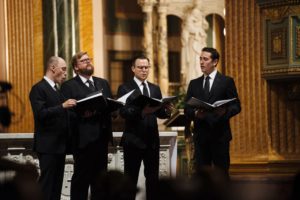 The program’s juxtaposition of ancient music with contemporary composition was brilliant. Thomas Tallis’s 16th-century Mass for Four Voices was flanked by short works of Andrew Smith (b. 1970) and Gabriel Jackson (b. 1962), Kyrie and Ite Missa est, respectively, both composed especially for New York Polyphony. The second half was devoted to Gregory Brown’s Missa Charles Darwin, commissioned by New York Polyphony. Using the traditional structure of the Latin mass as framework, Brown set excerpts of Darwin’s writings. It is a very successful, thought-provoking work, not least because the texts, while beautiful and poetic in and of themselves, are very pertinent to our concerns today about the environment. The concert concluded with Three American Folk Hymns arranged by Gregory Brown. We had a great turnout of 150 – ran out of programs and cookies;-)
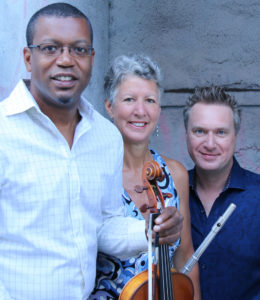 We were delighted to welcome Emerald Trio back for their second residency (the first having been in 2015, when they recorded Big Green Apple, their debut disc of all-new works composed especially for them, released last year to glowing reviews). This residency was all about breaking in a new pianist and work-shopping a new piece commissioned by Hill and Hollow Music for Emerald Trio. Composer-pianist James Sheppard wrote (pretty much on-site at Harvey House) a collection of five Adirondack-inspired miniatures that captured many moods and conjured many colorful images: “Adirondack Run,” “Saranac Shimmers,” “Alone Mountain,” “Farmers’ Duet,” and “Night Time Whiskey.” The premiere performance was enthusiastically received – the audience loved it!  We know that it will be programmed a lot on future Emerald Trio concerts.
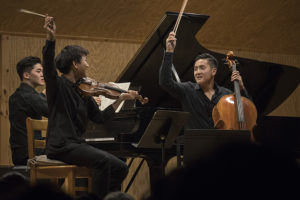 We were privileged to be host for an off-campus concert by advanced students of the renowned Meadowmount School of Music. The program began with Weilu Zhang playing two movements of the Sonata for Solo Violin in A minor, BWV 1003 by J.S. Bach. Then followed the exquisite Ravel Trio in A Minor with Liam Kaplan, piano; Nanao Yamada, violin; and Jeremy Tai, cello.  After intermission Jeremy Tai performed a movement Kodaly’s wildly virtuosic Sonata for Solo Cello, Op. 8. The concert’s glorious culmination was Schumann’s Quartet for Piano and Strings, Op. 47, with Matthew Harikian, piano; Weilu Zhang; violin; Aaron Rosengaus, viola; and Luiz Venturelli, cello.
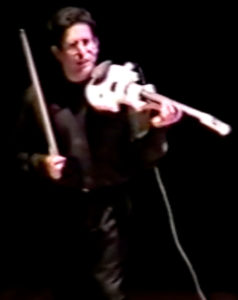 Classical violinist Jonathan Aceto brought out his ZETA electric violin for a great turnout at Weatherwatch Farm. He played two fascinating contemporary works for MIDI violin, background tape, and visuals: the hair-raising SAMPLER: Everything Goes When the Whistle Blows by Salvatore Martirano, inspired by the 1985 terrorist hijacking of the Achille Lauro cruise ship; and the otherworldly Desert Voices by Priscilla McLean, with a slideshow of photos of the Sonoran Desert, where many of the sounds on the background tape were recorded. In between, an aural  “palate cleanser,†Jonathan played the “Sarabande†from J.S. Bach’s unaccompanied Suite No. 3 in C with Grand Canyon reverb.
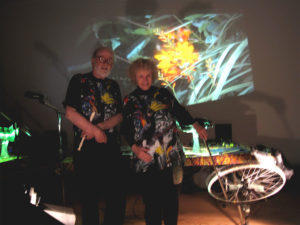 But to get everyone primed for the concert beforehand, the McLeans had created an interactive installation that utilized world music, sounds of nature, intriguing experimental techniques, and projected images. Small groups of 3 to 5 entered into a darkened room to experience, create, and manipulate music and sounds. Later, to round out the evening was a screening of Rainforest Images II, the evocative music-video by Barton and Priscilla McLean based on their adventures in Borneo, Malaysia, and Costa Rica. All the while there was plentiful eating and drinking – all good fun, punctuated with many beautiful, uplifting moments.